Claude Code Alternatives: What Operators Actually Need to Know (2026)

I have been driving Claude Code as my daily coding agent since the CLI shipped, and other infra engineers keep asking the same thing: what else is worth running, and why. The answer depends on where the agent lives (terminal, IDE, browser, autonomous runner), what model it can talk to, and how much of the runtime an operator is willing to operate themselves. Scope: coding agents I have run against three real repos (a 60K-LOC Python service, a 30K-LOC TypeScript monorepo, and the agentinfra-examples companion repo) over tens of unattended runs per tool between February and May 2026, with cost measured per-task from each tool's own usage line and cross-checked against the provider console.
TL;DR
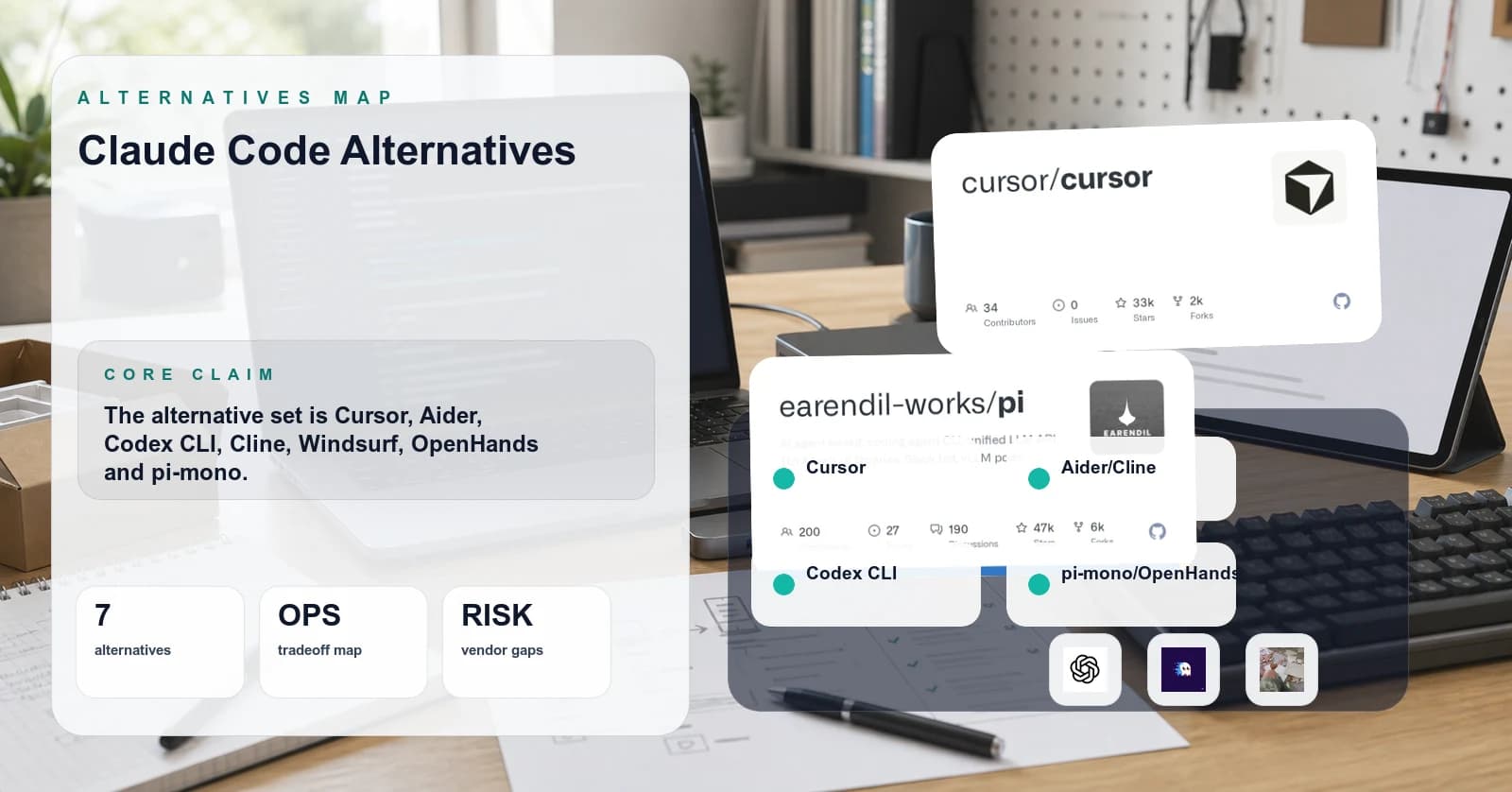
Pick Aider if the goal is a small, fast, scriptable terminal agent with git-commit-per-edit semantics and bring-your-own-key model freedom. Pick Cursor if the goal is an IDE-resident agent and Anysphere as a sub-processor on the code is acceptable. Pick Cline or Continue if the goal is VS Code agent panels without leaving the editor, pointed at any provider. Pick Codex CLI for the OpenAI ecosystem analogue to Claude Code's CLI loop. Pick Pi (badlogic/pi-mono) for a monorepo of agent primitives to read and fork. Reach for OpenHands only with a hard data-residency constraint that justifies operating a sandbox runtime. Everything else is a variation on these six postures.
This page is scoped to coding agents an operator runs against a real codebase. Not a survey of generic chat UIs, autocomplete-only tools, or "AI IDE" landing pages.
The mental model
Claude Code is a terminal-native coding agent. It reads files, edits them, runs shell commands, and loops on tool output until a task is done. The relevant axes for comparing alternatives are architectural, not feature-grid items:
- Where the agent lives. Terminal CLI, IDE fork, IDE extension, or remote runner.
- Who picks the model. Vendor-locked, bring-your-own-key, or gateway-routed.
- Who runs the sandbox. The vendor, the local machine, or your infra.
- How edits are committed. Per-turn git commits, apply-then-review patches, or speculative diffs in a side panel.
- What loop the agent runs. Single-turn tool-calling, react-style multi-step loop, or full autonomous runner with planner and verifier.
Marketing collapses these into "AI coding assistant." Operators care because each axis flips a different cost, security, and reliability tradeoff.
The landscape
The honest grouping as of 2026-05-07, with a clear line between tools I have run long enough to write about and tools I am only naming so the map is complete:
- Terminal-native CLIs: Claude Code (Anthropic), Codex CLI (OpenAI), Aider (open source), Pi (
badlogic/pi-mono, by Mario Zechner). - IDE forks: Cursor (Anysphere). Windsurf (Codeium) and Zed's built-in agent sit in the same cell with the same sub-processor question, but I have not driven either against production repos for long enough to teardown.
- IDE extensions: Cline (open source, VS Code) and Continue (open source, VS Code and JetBrains). GitHub Copilot's agent mode sits in the same cell with GitHub as sub-processor; same caveat.
- Remote autonomous runners: OpenHands as a self-hostable variant. Devin (Cognition) and Vercel's coding agents inside Sandbox sit next to it architecturally, with the runtime as the vendor's.
- Library-level: the Anthropic Agent SDK and the Vercel AI SDK.
Autocomplete-only tools (Tabnine, Supermaven, Copilot's classic mode) are out of scope. The teardowns and decision framework cover only tools I have actually run: Aider, Cursor, Cline, Continue, Codex CLI, Pi, and OpenHands.
What actually matters operationally
Vendor pages emphasize "supports 100+ languages" and "context window size." Neither matters much in production. What matters: whether the agent can run for 40 minutes against a real repo without burning a hole in a wallet, leaking source to an unapproved sub-processor, or producing diffs that look right and silently break a build.
Evidence note. Comparative claims here come from my own daily use, not a controlled benchmark. Setup across the runs: Claude Code 1.x and Codex CLI on macOS, Aider with --cache-prompts, Cline and Continue as VS Code extensions, pi-coding-agent via npm, and OpenHands in a local Docker sandbox. Version labels move quickly; at this recheck, @openai/codex was 0.128.0 on npm, @mariozechner/pi-coding-agent was 0.73.0, Cline's npm CLI package was 2.18.0, and Continue's CLI package was 1.5.45. Models routed directly: Claude Sonnet 4.6 (claude-sonnet-4-6) and Claude Opus 4.7 (claude-opus-4-7) on the Anthropic API, OpenAI Codex-rate-card models on OpenAI for Codex CLI, and a mix of Anthropic, OpenAI, and OpenRouter-routed open-weight models for the BYOK tools. Workloads: tens of unattended runs per tool against the three repos above. Operator experience, not a published benchmark.
The dimensions I weight, in order:
1. Tool-calling reliability under long loops. A coding agent is mostly tool calls. Reliability degrades with context length and depends on the model's training. In my own setup of refactoring tasks that span 200K+ tokens, Claude Sonnet 4.6 and Claude Opus 4.7 produce the most consistent tool sequences I have seen, with GPT-5-class models close behind. Open-weight models routed through OpenRouter lagged: malformed tool-call JSON, dropped arguments, occasional refusal to emit a tool call when context filled with shell output. The directional claim, that BYOK against open-weight backends underperforms first-party tools on long tool loops, is the load-bearing one.
2. Cost at the volume actually run. Exact token/day breakpoints age badly because subscription plans, model prices, and cache behavior all move. The durable shape is this: flat-rate seats are attractive when a user's work fits inside the plan's usage window; BYOK metering is attractive when usage is light, bursty, attributable, or routed through a discounted provider contract; heavy unattended loops can make either path expensive through repeated context reads. I track per-task token cost and serving model, not only seat fees, because seat-fee math hides usage caps and silent fallback is invisible in a monthly bill.
3. Data-flow precision. Whose machine reads the code. Whose model sees the prompts. Whose retention applies. "Stays on my laptop" is true of the editor surface only. The model call still leaves the machine.
4. Edit-commit semantics. Aider commits per turn. Claude Code applies edits then expects review before commit. Cursor and Cline run apply-or-reject panels. I prefer Aider's per-turn commits for unattended runs because each commit is a clean rollback point and git blame attributes every edit to the model turn.
5. Lock-in shape. A CLI talking to one provider is light lock-in. An IDE fork is heavier. A remote autonomous runner with proprietary scratchpads is heaviest.
6. Sandbox model. Local-machine execution is fast and has the largest blast radius: anything the user account can do, the agent can do, including rm -rf, git push --force, and outbound network calls to attacker-controlled URLs from a poisoned README. Vendor-managed sandboxes add 2-10s of cold-start latency on first command in exchange for Firecracker-class isolation. Self-hosted (OpenHands) gives the same isolation plus governance over which model endpoints the runner can call, at the cost of a runtime to patch and an on-call rotation.
I do not weight "context window size" highly for the workload I run. Multi-file refactors of 5-15 files, dependency upgrades, and test-failure triage fit comfortably under 200K input tokens per turn, and long-loop cost comes from iterated turns. Operators on whole-repo audits or cross-repo refactors should weight effective context (not advertised context) higher.
Detailed teardowns
Aider
Position. Terminal-native, BYOK, open source. The closest philosophical analogue to Claude Code, and it predates it.
Architecture. A Python CLI that reads the repo, talks to the model of choice via API, applies diffs, and commits per edit. Tree-sitter repo map, chat loop, small set of slash commands. No background runner, no remote sandbox, no IDE.
Cost / scale / ops. No seat fees. Three example calculations against Claude Sonnet 4.6 pricing as of 2026-05-07 ($3.00 per million input tokens, $15.00 per million output tokens, per https://platform.claude.com/docs/en/about-claude/pricing), prompt caching disabled:
- Small task (one-file tweak, ~15K input, ~2K output): ~$0.08 per task.
- Medium task (3-5 file refactor, ~80K input across 6 turns, ~10K output): ~$0.39 per task.
- Large task (multi-file migration, ~400K input across 20+ turns, ~40K output): ~$1.80 per task.
--cache-prompts against Anthropic can cut input-side cost roughly 90% on cache hits. Routing through OpenRouter to a discounted Sonnet variant or open-weight endpoint shifts input-side cost down by a similar order, at the price of weaker tool-calling reliability. Verify per-million-token numbers against live pricing before unattended runs.
When right. A scriptable agent. Git history that reflects every model edit. Switching providers freely. Terminal tools beat IDE forks. Reading the source in an afternoon is a feature.
When wrong. An integrated editor experience with hover, jump-to-def, and inline ghost text is the requirement. A vendor on the hook for outages. Long autonomous runs with planner-verifier loops.
Cursor
Position. A VS Code fork with an embedded agent and a paid product around it. Not BYOK by default. Anysphere routes model calls and adds product surface.
Architecture. Forked editor with local state and cloud-backed AI features. The agent panel calls Cursor's backend, which forwards to a model provider. The right read of https://cursor.com/data-use (fetched 2026-05-07) is closer to a table:
| Surface | Where data goes | Retention with Privacy Mode on |
|---|---|---|
| Editor + local state | Runs on the machine. | n/a for local-only state |
| Prompt + selected snippets (chat, agent, tab) | Cursor backend, then forwarded to provider as sub-processor | Privacy Mode controls retention/training, not routing |
| Codebase indexing chunks | Cursor says code chunks may be uploaded to compute embeddings; encrypted temporary file caches may exist server-side | Retention/training posture depends on Privacy Mode and the current data-use terms |
| Model inference | Provider receives prompt + context window | Provider-side ZDR posture depends on selected provider and mode |
| BYOK mode | Prompt still flows through Cursor's backend before provider call | Same Cursor-side routing rules |
Privacy Mode is a training and retention posture, not a residency guarantee. BYOK does not bypass Cursor's backend.
Cost / scale / ops. Per-seat subscription with usage tiers. Per https://cursor.com/pricing (fetched 2026-05-07), consumer plans are Hobby, Pro ($20), Pro+ ($60), and Ultra ($200); team plans are Teams ($40/user) and Enterprise (custom). Paid individual tiers advertise access to frontier models with higher usage multiples on Pro+ and Ultra. Verify dollar figures against live pricing.
What matters is the shape of the limits: a hard cap on premium-model requests inside the monthly window, a soft throttle that slows long sessions before the hard cap, and a fallback to a cheaper model class on some surfaces when the premium budget is exhausted. The fallback is the part that surprises operators, because a long agent run can quietly switch model class mid-task and produce noticeably worse diffs without an obvious signal. Track per-task token cost and the model actually serving each turn.
When right. A VS Code workflow with a preference for an agent one keystroke from the editor, accepting Anysphere as sub-processor.
When wrong. A hard data-residency constraint. A preference for fully BYOK with no intermediate processor. A dislike of vendor-fork editors.
Cline (and Continue)
Position. Two open source VS Code extensions for agentic edit-and-run loops. Both BYOK and provider-agnostic, at different points on the integration axis.
Cline architecture. A VS Code extension (with a separate standalone CLI binary) that talks directly to whichever provider is configured: Anthropic, OpenAI, OpenRouter, Bedrock, Vertex, or an OpenAI-compatible self-hosted endpoint. Edits land in apply-or-reject diff panels. Tool calls run in the local terminal. Configuration flows through the Cline settings UI inside VS Code or cline auth, with keys in the OS credential manager. Per https://docs.cline.bot/provider-config/openrouter and https://docs.cline.bot/cline-cli/getting-started (fetched 2026-05-07), there is no cline.* JSON shape in .vscode/settings.json despite blog posts to the contrary.
Continue architecture. A VS Code extension and a JetBrains plugin, which is the meaningful differentiator if the daily editor is IntelliJ, PyCharm, GoLand, or WebStorm. Configuration is file-based: a config.yaml (or older config.json) in ~/.continue/ declares models, providers, context providers, and slash commands as code, per https://docs.continue.dev/customize/overview (fetched 2026-05-07). Friendlier for teams that want to commit a shared agent config. Continue ships its own retrieval and context-provider system as named context providers a prompt can reference explicitly.
Cost / scale / ops. Both bill through whichever provider they point at, no seat fee. Trivial for a solo operator, slightly more annoying for a team that wants centralized billing without a gateway.
When Cline is right. Cursor-style agent ergonomics on a stock VS Code install with apply-or-reject panels. The standalone CLI is the cleanest way to drive Cline from a script.
When Continue is right. A JetBrains-first workflow, or a preference for declarative file-based configuration that can be checked into a repo or dotfiles tree.
When either is wrong. Polished onboarding, vendor support contracts, and a single throat to choke. Cline's loop changes between releases; Continue's config schema has migrated more than once.
Codex CLI
Position. OpenAI's terminal coding agent. The OpenAI-shaped analogue to Claude Code's CLI.
Architecture. A terminal CLI that authenticates to OpenAI, drives a tool loop against the repo, and applies edits. Model-locked to OpenAI's Codex-specific family.
Cost / scale / ops. Two auth paths. Per https://developers.openai.com/codex/cli, https://developers.openai.com/codex/pricing, and https://help.openai.com/en/articles/11369540-codex-in-chatgpt (fetched 2026-05-07), the CLI signs in with a ChatGPT account or an API key. Codex is included with ChatGPT Plus, Pro, Business, Edu, and Enterprise plans, subject to plan limits; API-key use bills metered API usage. Model selection follows the CLI version and configuration rather than one fixed legacy Codex family: the CLI docs expose /model, and the current Codex pricing page lists GPT-5.5, GPT-5.4, GPT-5.4-Mini, GPT-5.3-Codex, and GPT-5.2 among its usage/pricing tables.
When right. Already paying for ChatGPT Business or Enterprise. Already in the OpenAI ecosystem at the API level. A CLI agent posture without dependency on Anthropic.
When wrong. Provider freedom matters. The plan's Codex rate limits get hit on long unattended runs. A non-OpenAI model is the right tool for a given task.
Pi (badlogic/pi-mono)
Position. A monorepo of agent primitives by Mario Zechner, about 45.8K stars on GitHub as of 2026-05-07. The relevant piece is the coding-agent CLI inside it, published as @mariozechner/pi-coding-agent (0.73.0 when rechecked). The rest is a kit: unified LLM API client, TUI and web UI libraries, supporting tooling. I have run pi-coding-agent as the agent harness for one of my internal production apps; the loop is fast, in part because there is less framework between the model call and the shell.
Architecture. Ships as an npm-installable CLI built on pi-mono's own LLM API package, BYOK. Per the README at https://github.com/badlogic/pi-mono (fetched 2026-05-07), the supported install path is npm install -g @mariozechner/pi-coding-agent. The wider monorepo exposes the LLM client, agent loop, and UI primitives as separate packages.
Cost / scale / ops. Provider bills directly, no seat fee. Two postures: install the published CLI globally and treat it like Aider, or clone and maintain a fork.
When right. A small fast terminal coding agent with BYOK and pinned npm version. Operators who want one tree containing the LLM client, agent loop, and UI primitives so pieces can be pulled into other projects. Mario's taste (few dependencies, low ceremony, source as docs) shows through.
When wrong. A vendor on the hook for outages or a tool to hand to non-engineers. The README and source are the support contract.
OpenHands (self-hosted autonomous runner)
Position. Open source agent runner operated yourself. Closer to Devin than to Claude Code, but the runtime is yours.
Architecture. A planner-and-runner loop in a container with a sandboxed shell, file system, and browser. Bring the model. Operate the host.
The residency caveat that decides whether OpenHands actually solves the problem. Self-hosting the runner gives runtime residency, not inference residency. The runner still has to call a model. If that call goes to public Anthropic, OpenAI, or any third-party API, prompts and code-context leave the VPC to a model vendor as sub-processor, exactly the thing the self-host was supposed to prevent. To actually keep prompts and code inside an approved boundary, the model endpoint has to live there too: Anthropic on AWS Bedrock or GCP Vertex inside the account, Azure OpenAI inside the tenant, or a self-hosted open-weight model behind a vLLM-compatible endpoint. Without one of those, OpenHands solves half the problem and a security review will catch the other half.
When right. A regulatory or contractual reason that prompts and code cannot leave infra, AND a model endpoint inside that same boundary. Capacity to support and patch a runtime.
When wrong. Anything else. Ops cost dwarfs subscription savings unless at meaningful scale.
The model-routing layer
Every alternative above eventually has to make a model call. Operators with multi-vendor stacks usually want OpenRouter (hosted gateway) or LiteLLM (self-hosted proxy) in front of those calls. Cline, Continue, and Aider work cleanly behind either, and the picture for Claude Code is more nuanced than "unsupported."
Anthropic documents an LLM gateway path for Claude Code. Per https://code.claude.com/docs/en/llm-gateway (fetched 2026-05-07), operators can point Claude Code at a LiteLLM proxy by setting ANTHROPIC_BASE_URL to the proxy, using documented auth helpers (apiKeyHelper for dynamic keys), and routing through pass-through endpoints that preserve Anthropic's API shape. That path is sanctioned, and it is the right choice for centralized billing, audit logging, regional routing, or fan-out to Anthropic on Bedrock or Vertex. Cursor remains first-party tied to Anysphere's backend.
Where the path stops being sanctioned is non-Claude model translation. Pointing Claude Code at a gateway that rewrites requests to a non-Anthropic model is a separate posture. In my own testing it works in toy cases and breaks on real tool-calling workloads, because the tool-call structure Claude Code emits is tuned to Anthropic models and survives translation poorly. Gateway routing to Claude (including Claude on Bedrock or Vertex through LiteLLM) is documented and works; cross-provider model translation is the experimental part.
Things nobody talks about
Operational realities vendor pages skip. Each one cost me time before I learned it.
1. Long agent runs blow through subscription caps faster than the marketing implies. A flat-rate seat looks unbeatable until an agent loops on a 30-file refactor for an hour. The cap is real, the throttle is real, and it bites mid-task. Mitigation: track tokens per task in own logging. "Unlimited" in marketing is never literally unlimited.
2. Tool-calling reliability degrades unevenly across providers. A model that benchmarks well on isolated coding evals can still produce malformed tool calls when context fills with shell output. Anthropic's Sonnet and Opus and OpenAI's frontier models hold up best on long loops. Open-weight 70B-class models lose tool-call structure on complex multi-file tasks. Routing Cline or Aider to a discounted open-weight model means babysitting it more.
3. Local-machine sandboxing is not sandboxing. Aider, Claude Code, Cline, and Continue all run shell commands as the user on the laptop. A confused agent can rm -rf something it should not, push to the wrong remote, or curl an attacker's URL because a prompt injection lived in a README. Mitigation: dev-container isolation, a separate user, or a VM. Vendors do not loudly advertise this.
4. "Code stays on my laptop" has five different answers depending on which Cursor surface fired. The marketing collapses prompts, embeddings, indexing, retention, privacy mode, and BYOK into one bullet. The data-flow is granular (see the table in the Cursor teardown above). Privacy Mode affects training and retention posture, not whether AI requests route through Cursor's backend. If a security review asks "does our code leave the editor," the honest answer is "yes, for model-backed surfaces, to Cursor as processor, then to the model provider as sub-processor."
5. Migrating off an autonomous runner is harder than migrating off a CLI. Aider's "state" is git history, so leaving Aider is free. Claude Code, Codex CLI, and Pi are similar. Cursor's state is heavier (editor settings, local index, indexed-chunk embeddings on Anysphere's side). Devin-class runners accumulate scratchpads, plans, and per-project tuning that does not export cleanly. Lock-in is proportional to how much state the tool keeps that is not git history.
6. The "background agent" pitch hides a queue and a quota. Cursor, Devin, and similar tools advertise running tasks while the operator sleeps. The catch: those background runs share usage quota, fail silently when they hit it, and produce PRs the operator still has to read. The unattended-agent dream is real, the cost picture is not unmanaged.
Implementation patterns
Working code lives in the companion repo: https://github.com/MPIsaac-Per/agentinfra-examples. Three patterns I use across these tools.
Pattern A: Aider with a real spend cap. Useful for unattended runs. --map-tokens and --cache-prompts do not cap spend. The actual guardrails live one layer up: a provider-side budget (Anthropic billing limits, or an OpenRouter key with a hard credit cap), plus a wrapper that watches Aider's usage report and kills the process when a per-task ceiling trips.
# Aider, against Anthropic Sonnet.
# Verify current pricing at https://platform.claude.com/docs/en/about-claude/pricing before unattended runs.
# Set a hard provider-side cap first:
#   - Anthropic console: Workspace -> Limits -> monthly USD ceiling
#   - or use an OpenRouter key with a credit balance you are willing to lose

set -euo pipefail
TASK_BUDGET_USD=2.00
LOG=/tmp/aider-run-$$.log

aider \
  --model anthropic/claude-sonnet-4-6 \
  --auto-commits \
  --map-tokens 1024 \
  --cache-prompts \
  --message-file ./tasks/refactor-auth.md \
  2>&1 | tee "$LOG" &
AIDER_PID=$!

# Aider prints a running "Tokens: ... Cost: $X.XX session" line.
# Tail it, parse the session cost, kill if it crosses the per-task ceiling.
( tail -F "$LOG" | awk -v cap="$TASK_BUDGET_USD" -v pid="$AIDER_PID" '
    /Cost:/ {
      for (i=1; i<=NF; i++) if ($i ~ /^\$[0-9]/) { gsub(/\$/, "", $i); cost=$i+0 }
      if (cost > cap) { system("kill " pid); exit }
    }' ) &
wait "$AIDER_PID"
--auto-commits is the default and the reason I prefer Aider for unattended work: every model edit is a separate commit revertable with one command.
Pattern B: Cline pointed at OpenRouter for model freedom. Cline does not read API keys from .vscode/settings.json, and the cline.* workspace-settings shape from blog posts is not the official config path. As of 2026-05-07, the documented setup is the Cline settings UI (gear icon, API Configuration, pick OpenRouter, paste key, pick model) or the CLI equivalent. Keys in OS credential manager. Source: https://docs.cline.bot/provider-config/openrouter and https://docs.cline.bot/cline-cli/overview.
# Cline standalone CLI, OpenRouter provider, model selected at auth time.
# Stores the key in the OS credential manager, not in any repo file.
cline auth -p openrouter -k "$OPENROUTER_API_KEY" -m "anthropic/claude-sonnet-4.6"
For the VS Code extension, do the same through the Cline panel's API Configuration screen. Auto-approval stays off. Watching the agent ask before each shell command is the cheap version of a sandbox.
Pattern C: Claude Code with explicit context guardrails. Useful when the repo is large and the agent has paths it should not touch.
# Claude Code, with a project-level CLAUDE.md telling it what is out of scope.
# CLAUDE.md sits at the repo root and is auto-loaded.

cat > CLAUDE.md <<'EOF'
# Project rules
- Do not edit anything under vendor/ or third_party/.
- Run `pnpm test --filter=affected` before claiming a task done.
- Commit messages: imperative mood, under 72 chars, no marketing words.
EOF

claude
Most of the operational quality of Claude Code comes from a tight CLAUDE.md.
Decision framework
Pick by the constraint that hurts most.
- Constraint: provider freedom and per-edit git history. Aider.
- Constraint: VS Code with a polished agent panel without forking the editor. Cline or Continue.
- Constraint: lowest-friction integrated experience, accepting the sub-processor. Cursor.
- Constraint: Claude Code posture but the org is OpenAI-aligned. Codex CLI.
- Constraint: a hard data-residency requirement. Two decisions, not one. Runtime residency means the agent loop, shell, and file system stay inside an approved boundary; OpenHands self-hosted gives that. Inference residency means the prompts and code-context the agent sends to a model also stay inside that boundary, which a self-hosted runner does not give on its own. Pair the runner with a private model endpoint: Anthropic on AWS Bedrock or GCP Vertex inside the account, Azure OpenAI inside the tenant, or a self-hosted open-weight model behind a vLLM-compatible endpoint.
- Constraint: a kit to read and fork, not a packaged product. Pi (
badlogic/pi-mono).
A practical setup I recommend: keep Claude Code as the primary CLI, keep Aider on disk for cases that want git-per-edit semantics or a non-Anthropic model, and add Cline only for an in-editor agent panel for browsing-style work. Three tools, complementary, no lock-in. Seat fees are zero or low because the artifact is always git.
A note on what is out of scope. Windsurf, Zed's agent, Copilot agent mode, Devin, and Vercel's agents are members of the landscape, but I have not run any long enough on production codebases to recommend. The axes in "The mental model" above are how I would evaluate each.
The space is moving fast. The piece I would not bet on is the remote autonomous runner category at current pricing; value-per-dollar is worse than a synchronous CLI loop in most coding work I do, and lock-in is heaviest. The piece I would bet on is the boring one: terminal-native CLIs with good tool-calling models, used against well-curated repo rules. That is where productivity actually compounds.