Enterprise Procurement Is The Real AI Coding Benchmark

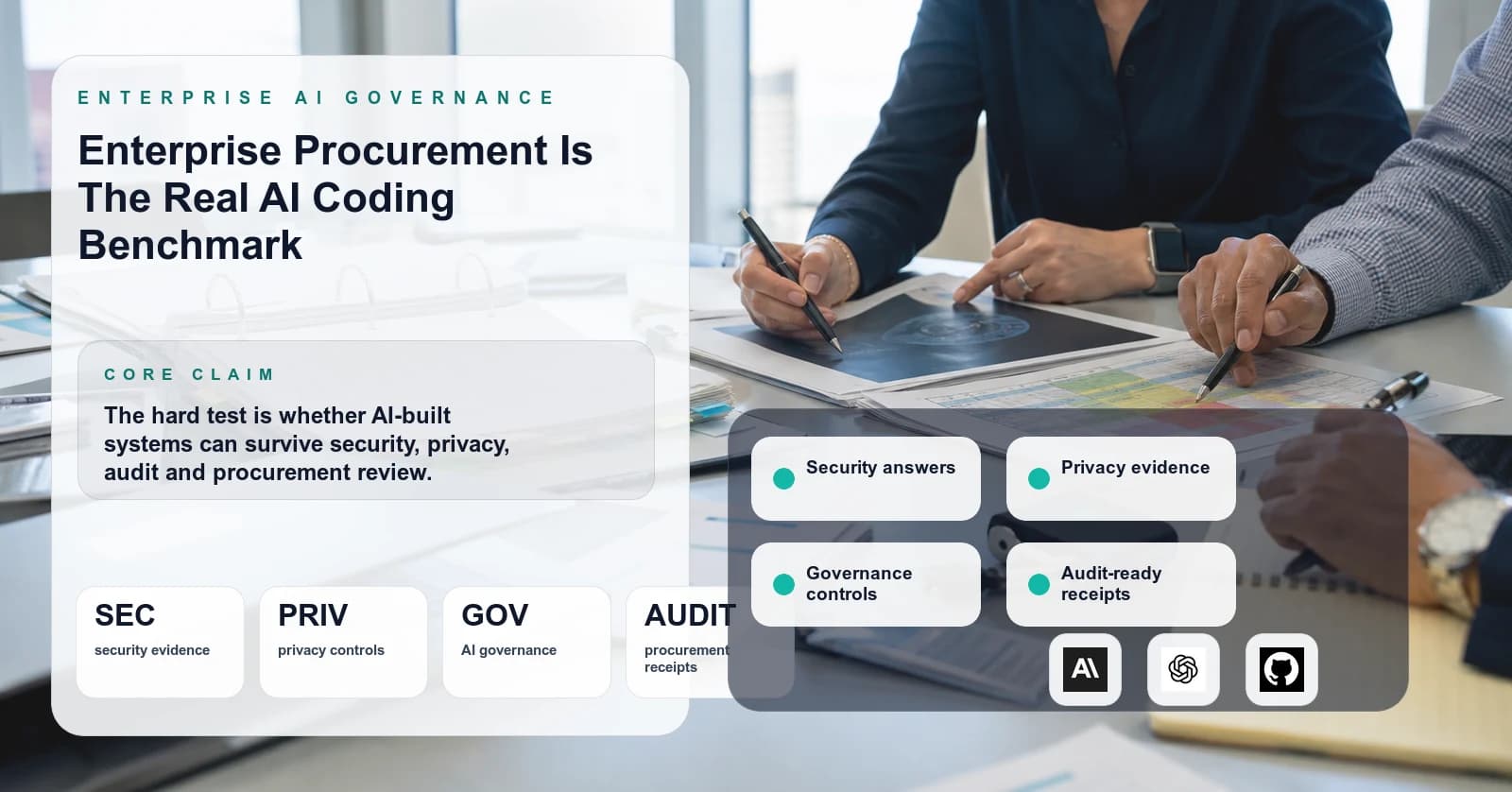
I posted a short line on X that is doing more work than it looks like:
The real benchmark for AI augmented coding is enterprise procurement.
That is the standard I keep coming back to.
Not SWE-bench. Not a demo video. Not "look how many files changed." Not even the raw count of tool calls, traces, or agent loops.
Those things matter. I spend a lot of time measuring them. But they are not the finish line.
The harder question is this:
Can the output of AI-augmented coding survive enterprise procurement?
Can it answer the security questionnaire? Can it explain who can access data, where the data goes, which sub-processors are involved, what happens during an incident, how data subject requests are handled, how model providers are controlled, and how every meaningful claim can be evidenced?
That is the test.
Coding Benchmarks Measure The Easy Part
Most AI coding benchmarks measure one of three things:
- Can the model solve a contained programming task?
- Can it modify an existing codebase without breaking tests?
- Can it navigate a repo well enough to produce a plausible patch?
Those are useful measurements. They tell us something about model capability and developer experience.
But they do not tell us whether the resulting system can operate inside a real company.
Enterprise software is not just code. It is a bundle of obligations:
- authentication and authorization
- tenancy boundaries
- secrets management
- vendor and sub-processor control
- logging and auditability
- incident response
- data retention and deletion
- privacy operations
- model routing
- procurement artifacts
- support ownership
- change management
- control evidence
This is where the conversation about AI coding gets thin.
A model that can produce a working feature is useful. A harness that can produce an enterprise-ready application is something else.
Procurement Is Where The Fantasy Ends
Enterprise procurement has a clarifying effect.
It takes vague claims and turns them into yes-or-no questions:
- Do you have a sub-processor register?
- Are AI providers approved per engagement?
- Can customer data be routed away from non-approved systems?
- Can you prove which systems receive which categories of data?
- Do you have a breach process?
- Who owns notification decisions?
- How do you handle access reviews?
- Can data subject requests be routed correctly?
- Are logs retained?
- Are sensitive fields minimized?
- Are AI actions authorized, traceable, and bounded?
- Which controls are live, partial, planned, or unverified?
This is not a marketing exercise. It is where software starts being treated as part of the buyer's risk surface.
And that is exactly why it is a better benchmark.
The question is not whether an AI agent can produce code that looks real. The question is whether a serious organization can look at the resulting system and say: this is governed enough to put near our workflows.
The Mistake Is Treating Compliance As Paperwork
The common failure mode is to build the app first, then staple compliance language onto the side.
That does not hold up.
Security, privacy, and AI governance are not after-the-fact documentation chores. They change the shape of the system:
- If sub-processors must be allowlisted, the runtime needs provider controls.
- If customer data cannot flow freely, the architecture needs data classification and routing boundaries.
- If AI actions must be explainable, the system needs audit trails and decision records.
- If a buyer asks about breach response, there needs to be an operational owner and a process, not just a sentence in a policy.
- If a claim is only partially implemented, the evidence register needs to say partial, not pretend it is done.
This is the difference between building a demo and building an enterprise product.
The demo says: look what the agent can do.
The product says: here is what the system will not do, here is how we know, and here is who owns the remaining gap.
The Output Changed My View
Over the last six to nine months, the thing that changed my view was not just the research. It was the output.
AI-augmented development let me build and harden a portfolio of real application surfaces at a pace that would have been hard to explain a few years ago: multi-tenant SaaS systems, agent control planes, internal developer tools, autonomous research and publishing pipelines, market-intelligence workflows, API gateways, plugin systems, model-routing layers, customer-facing demos, and production infrastructure around them.
One example: I took an open agent/chat assistant base, stripped it down to architectural roots, and rebuilt it into a multi-tenant enterprise assistant platform with gateway controls, channels, authentication, plugins, model routing, operational boundaries, and governance hooks.
That matters because it is not just "the agent wrote code."
The meaningful result is that AI-assisted coding can compress the distance between:
- product concept
- working application
- operational controls
- governance artifacts
- procurement evidence
- customer-ready implementation
That last part is the unlock.
The world does not need more AI demos that cannot pass a security questionnaire. It needs more small teams that can build serious systems with the evidence discipline enterprises expect.
ISO-Ready Is A Different Bar Than Demo-Ready
There is an important phrase I use carefully: ISO-ready.
ISO-ready does not mean ISO certified. It does not mean an external auditor has signed off. It does not mean every control is complete.
It means the system is being built in a way that expects audit:
- claims are written down
- controls have owners
- registers exist
- sub-processors are tracked
- gaps are named
- remediation has dates
- evidence can be produced
- privacy processes are operationalized
- AI governance is not just a principle document
This matters because enterprise buyers can tell the difference.
"We care about security" is not an answer.
"Here is the control, here is the owner, here is the evidence, here is the status, and here is the open gap" is an answer.
That is a much higher bar for AI-augmented coding. It is also the bar that matters.
The Five Procurement Tests
If I were designing a benchmark for serious AI-augmented software delivery, I would not stop at unit tests or issue completion. I would add a procurement gauntlet.
1. Sub-Processor Control
Modern AI systems often depend on model providers, cloud vendors, observability services, authentication providers, email systems, storage providers, vector databases, and support tooling.
Procurement does not care that this is normal. Procurement asks whether the buyer knows where data is going.
A serious system needs a sub-processor model:
- which vendors are used
- what each vendor does
- what data categories each vendor may receive
- whether the vendor is always used or only used for specific workflows
- whether a customer can approve or restrict usage
- how provider changes are handled
For AI systems, this becomes especially important because model routing can be dynamic. If the runtime can choose between providers, the governance layer must be able to constrain that choice.
The benchmark is not: can the model call another model?
The benchmark is: can the system prevent non-approved provider usage for a governed engagement?
2. Runtime Governance
Policies are useful. Runtime enforcement is better.
An AI governance policy that does not connect to the actual execution path is only half a control.
For agentic systems, governance belongs close to the loop:
- what tools are available
- what actions require approval
- which data classes can be sent to which providers
- which models are allowed for which tasks
- which outputs require human review
- which logs are retained
- which operations are blocked by default
This is where AI coding has to grow up.
The interesting engineering is not just prompt quality. It is the harness around the model: permissions, routing, observability, durable records, and failure handling.
The research I have been publishing points in the same direction. Agents are not magic chat boxes. They are operating loops: search, read, edit, run, inspect, retry, summarize. Once you see them that way, governance becomes an execution problem, not a branding problem.
3. Evidence Registers
Enterprise buyers do not only ask what the product does. They ask how you know.
That requires evidence.
Not vibes. Not a promise. Evidence.
For a serious AI-assisted build, every important claim should be able to survive a register:
- control area
- claim
- implementation status
- owner
- evidence link or verification method
- open gap
- remediation plan
- target date
The status field matters.
Some controls are live. Some are partial. Some are planned. Some are unverified. A mature organization can say that plainly.
This is one of the strongest signals of enterprise readiness: the ability to distinguish between what is implemented, what is designed, what is policy-only, and what still needs evidence.
4. Privacy Operations
AI systems touch privacy in ways that ordinary SaaS systems already did, but with more routing complexity and more pressure on explainability.
A procurement-ready system needs answers for:
- what personal data is processed
- whether customer content enters model contexts
- how data is minimized
- how data subject requests are handled
- who determines controller or processor responsibilities
- how deletion is propagated
- how incidents are classified
- who is notified and when
- how logs are treated
This is not legal decoration. It affects product design.
For example, if the system cannot identify where a user's data may exist, it cannot service deletion requests confidently. If logs capture too much, observability becomes a privacy risk. If model inputs are not classified, routing controls become guesswork.
The procurement benchmark asks whether these realities are built into the operating model.
5. Honest Maturity
The strongest enterprise posture is usually not pretending everything is finished.
It is showing that the organization knows exactly what is finished, what is partial, what is planned, and what is not yet verified.
That is especially true for AI governance.
The market is full of inflated claims:
- "secure by design"
- "enterprise-grade"
- "compliant"
- "audit-ready"
- "private"
- "responsible AI"
Those phrases are weak unless they map to evidence.
Honest maturity looks different:
- this control is live
- this one is partial
- this gap has an owner
- this vendor is approved only for this data class
- this model is blocked for this engagement
- this audit trail exists
- this policy exists but runtime enforcement is still being implemented
That is the language of serious software.
The Research And The Output Are Converging
The research thread I keep returning to is simple:
AI coding agents are not best understood as chat interfaces. They are runtime systems.
They search. They inspect. They edit. They run commands. They branch. They get stuck. They recover. They generate misleading confidence when verification is weak. They become dramatically more useful when wrapped in better harnesses.
That research explains the output.
The reason one operator can build so much more now is not because the model is a perfect engineer. It is because the work can be decomposed into loops:
- inspect the current system
- identify the smallest next change
- edit
- test
- review
- collect evidence
- repeat
When those loops are connected to a good repo structure, a good task model, a good verification habit, and a governance layer, AI-augmented coding becomes much more than autocomplete.
It becomes a way to compress product development, compliance preparation, and operational hardening into the same daily workflow.
That is the thing worth talking about.
Not "I made a toy app in a weekend."
"I built real systems and can put them through enterprise diligence."
The New Builder Skill Stack
This changes what the high-leverage builder looks like.
The next generation of AI-native software operators will not just be prompt engineers. They will need to be part product engineer, part platform engineer, part security operator, part compliance translator, and part evidence librarian.
The valuable skill is not only getting the agent to produce code.
The valuable skill is knowing what evidence the code will eventually need.
That means asking different questions while building:
- What would a buyer ask about this workflow?
- What would security need to approve?
- What data enters this path?
- Which vendor touches it?
- Which action needs a human gate?
- What should be logged?
- What should not be logged?
- How would we prove this control works?
- What happens if the model is wrong?
- What happens if the provider changes?
- What happens if the customer says no to this sub-processor?
These questions are not blockers. They are design inputs.
AI makes software cheaper to produce. That means the scarce resource moves upward: judgment, governance, verification, and operational taste.
What I Would Measure Next
If the industry wants better benchmarks for AI-augmented coding, I would measure the path from generation to governance.
For example:
- time from feature request to working implementation
- time from implementation to tested implementation
- time from tested implementation to documented control evidence
- percentage of product claims with linked evidence
- percentage of AI actions with traceable authorization
- percentage of vendors mapped to data categories
- number of runtime paths blocked by policy
- mean time to answer a procurement question
- number of controls with live, partial, gap, and unverified statuses
- number of security or privacy claims revised after evidence review
Those metrics would tell us much more than a demo.
They would tell us whether AI is helping teams build software that can actually be bought.
The Bottom Line
AI-augmented coding is not impressive because it generates code quickly.
It becomes impressive when the output can survive contact with enterprise reality:
- security review
- privacy review
- AI governance review
- vendor review
- incident-response expectations
- audit evidence
- procurement scrutiny
That is why I think enterprise procurement is the real benchmark.
It turns agentic coding from a productivity claim into an operating claim.
Can you build it?
Good.
Can you govern it, evidence it, restrict it, explain it, and support it in front of a serious buyer?
That is the test.